ErgoFoundry is reader-supported. When you buy through our links, we may earn a commission at no extra cost to you. We test and research every product we recommend.
"Sitting Is the New Smoking" — Where That Came From and Why It's Wrong
The phrase "sitting is the new smoking" has been repeated so often it's become wallpaper — background noise that everyone nods at and no one questions. It was popularized around 2010 by Dr. James Levine at the Mayo Clinic, who was studying NEAT (Non-Exercise Activity Thermogenesis) and the metabolic effects of prolonged sitting. Levine's actual point was nuanced: our environment has engineered movement out of daily life, and that has metabolic consequences. The headline version stripped away all nuance.
Here's what the metaphor gets right: prolonged sitting is genuinely associated with poor health outcomes. The evidence on this is strong and consistent. Sitting for 8+ hours a day correlates with higher rates of cardiovascular disease, type 2 diabetes, and all-cause mortality. The mechanisms are real — extended sitting reduces lipoprotein lipase activity (an enzyme that breaks down fats in the blood), slows glucose metabolism, and creates sustained compression on spinal discs.
Here's what the metaphor gets catastrophically wrong: smoking kills you no matter what else you do. A pack-a-day smoker who runs marathons still has dramatically elevated cancer and cardiovascular risk. Sitting is different — its negative effects are highly modifiable. And the key factor isn't whether you sit or stand. It's whether you move.
The Hard Numbers: Sitting Time and Mortality
Let's look at the best studies — the big ones, recently published, in reputable journals.
A 2024 study in JAMA Network Open examined occupational sitting and all-cause mortality in 481,688 participants over an average follow-up of nearly 13 years. The headline finding: people who predominantly sit at work have a 16% higher all-cause mortality risk compared to those who predominantly don't sit. That's a real number from a massive dataset — not a blog post citing a blog post citing a headline.
But here's the finding that most coverage missed: that 16% elevated risk was essentially eliminated in people who engaged in just 15-30 minutes of daily leisure-time physical activity. Fifteen to thirty minutes. A short walk at lunch. A bike ride after dinner. That was enough to erase the mortality gap between sitters and non-sitters.
A 2024 BMC Medicine meta-analysis on sedentary behavior replacement reached a similar conclusion: replacing 30 minutes of sitting with 30 minutes of moderate-to-vigorous physical activity was associated with meaningful reductions in mortality risk. Replacing sitting with standing showed much smaller benefits — the real gains came from actual movement.
The nuance most articles miss: it's not sitting itself that's deadly. It's the absence of movement. Sitting is just the most common way that desk workers are stationary. Standing still for 8 hours would carry its own set of problems — and we have data on that too.
What Standing Desks Actually Change (According to Randomized Controlled Trials)
This is where we separate what's studied from what's assumed. Randomized controlled trials — the gold standard in medical research — have been run on standing desk interventions. Here's what they found:
Blood pressure: The RESET-BP trial, published in Circulation (2024), examined whether a sit-stand desk intervention could reduce blood pressure in desk workers. The result: a modest but statistically significant reduction of roughly 3 mmHg in systolic blood pressure. Not earth-shattering, but clinically meaningful — a population-wide 3 mmHg reduction in systolic BP would save thousands of lives annually from stroke and heart disease.
Sitting time reduction: The "Stand and Move at Work" study, with a 24-month follow-up published in 2025, found that sit-stand desk interventions reduced sitting time by roughly 60 minutes per workday. That's substantial. But the same study found diminishing adherence over time — at 24 months, the reduction was smaller than at 6 months. People's enthusiasm for standing wanes. The equipment is there; the habit needs maintaining.
Productivity: A 2025 study in the Journal of Occupational and Environmental Medicine (JOEM) found that sit-stand desk converters reduced sitting time and improved self-reported productivity. A PubMed-indexed 2-year follow-up from 2025 showed workers maintained standing habits but at reduced levels compared to month one. The pattern is consistent: standing desks work, but the initial enthusiasm fades and what remains is a smaller but still meaningful reduction in sitting time.
Back Pain: The Most Reliable Benefit

If you're looking for the single strongest, most consistently replicated benefit of standing desks, it's this: they reduce lower back pain.
A systematic review of sit-stand desk interventions on lower back pain (LBP) found consistent results across multiple studies: participants reported 30-50% reductions in self-reported LBP when alternating between sitting and standing. The mechanism isn't about "correct posture" — it's about movement variety and reduced static loading on spinal structures.
Your intervertebral discs don't have their own blood supply. They get nutrients through diffusion, which is driven by pressure changes — loading and unloading the spine pumps fluid in and out of the discs. Sitting in one position for hours eliminates that pumping action. Standing in one position for hours does the same thing in a different direction. Alternating between the two restores the pressure cycles that keep discs healthy.
Important caveat: standing desks can cause back pain if you stand too long without moving. Prolonged static standing creates its own compression pattern — especially on the facet joints in the lower spine. Standing isn't inherently better than sitting. Movement variety is. A standing desk that enables you to switch positions is beneficial. A standing desk at which you stand rigidly for 3 hours is not.
What Standing Desks DON'T Do (Despite the Hype)
This section will disappoint anyone who bought a standing desk hoping it would solve everything. Here's what the data does not support:
Meaningful weight loss: Standing burns roughly 8-10 extra calories per hour compared to sitting. Over an 8-hour workday, that's about 80 calories — roughly a single apple. Not nothing, but not a weight loss strategy. The metabolic difference between sitting and standing is trivial. If weight loss is your goal, a standing desk is an ergonomic tool, not a fitness tool. You need actual exercise.
Replacing exercise: Standing is not exercise. It's a different posture — one that engages slightly more muscle activity than sitting (you're using your legs to hold yourself up), but nowhere near the level of even a slow walk. A standing desk is complementary to an active lifestyle, not a substitute for one.
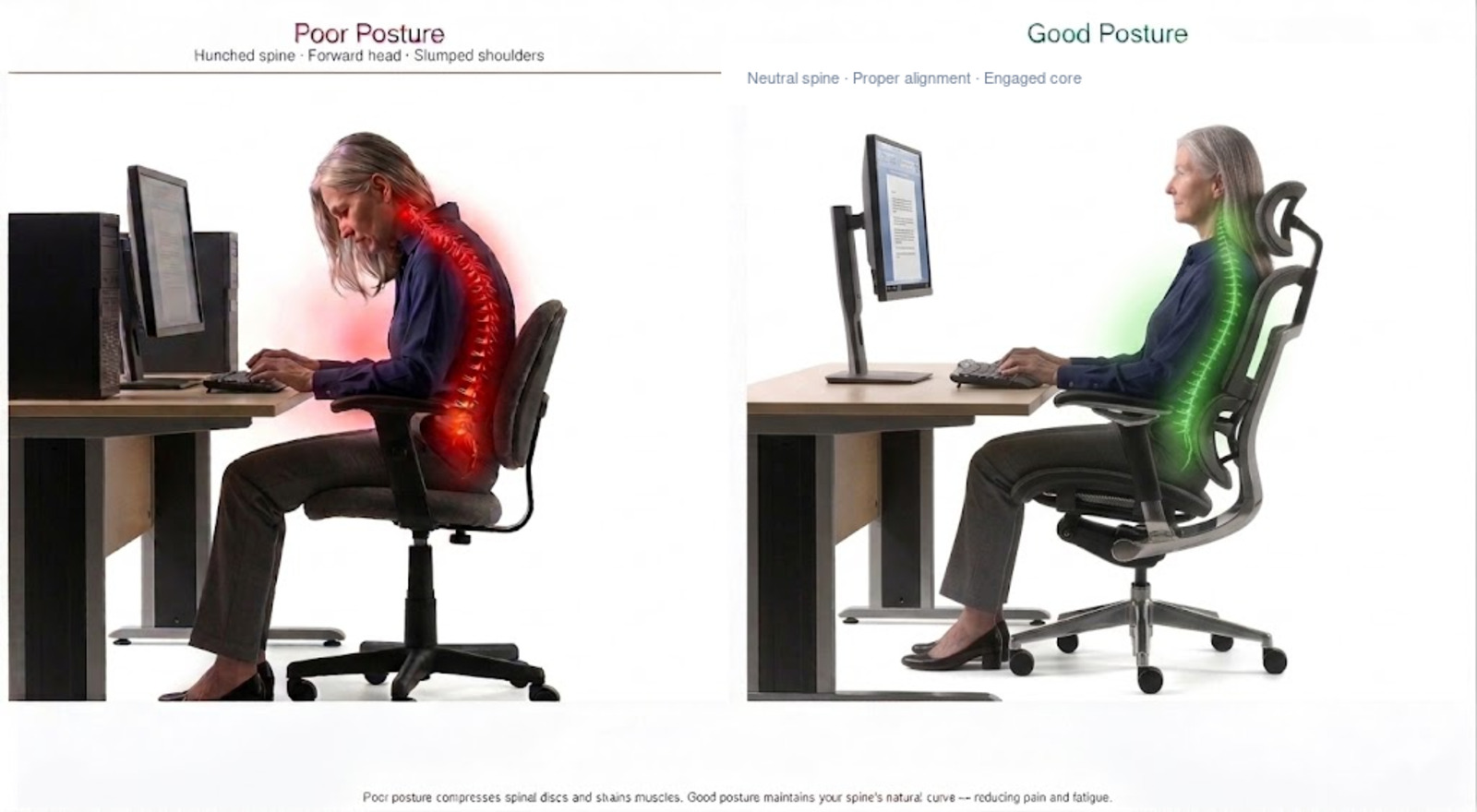
Fixing poor posture on its own: "Standing badly" is absolutely a thing. You can stand with your hips tilted forward, your shoulders rounded, your head craned toward a too-low monitor, and your weight shifted to one hip. In that position, standing is worse than sitting properly. The desk doesn't fix your posture — it creates the opportunity for better posture. You still have to actually use it correctly.
Productivity boosts (the evidence is mixed): Some studies show improvements in self-reported productivity; others show no difference. Some show a slight drop during the adjustment period. The honest answer: for most people, productivity is about the same. You won't magically become more efficient by standing. You might become more comfortable, which could indirectly support focus — but the direct productivity link is weak.
The Goldilocks Zone — It's Not Sit OR Stand, It's Move
A 2024 editorial in The BMJ titled "Standing desks may not be the panacea we hoped" crystallized what the research had been hinting at for years: prolonged standing carries its own risks — varicose veins, joint compression, foot pain, and increased cardiac afterload (your heart working harder to pump blood against gravity).
The emerging consensus from the best studies recommends a rhythm, not a position:
- 20-30 minutes sitting — focused work, leaning back slightly (not bolt upright), with proper lumbar support
- 8-10 minutes standing — stretch, take calls, review documents, lighter tasks
- 2 minutes walking — move your body, reset your posture, get your blood flowing
- Repeat throughout the day
This sit-stand-sit rhythm matters more than total standing time. Standing for 4 continuous hours is arguably worse for your body than sitting for 4 continuous hours, because you're bearing your full body weight on your feet, legs, and spine the entire time. The ideal isn't standing. It's changing positions frequently.
Who Benefits Most from a Standing Desk?
Based on the research, here's who gets the most value from a sit-stand desk:
- People with existing lower back pain — Strongest evidence. The 30-50% reduction in LBP from alternating sit-stand is the most consistent finding across studies.
- Desk workers with less than 30 minutes of daily physical activity — These are the people at highest mortality risk from occupational sitting. A standing desk alone won't fix that, but combined with building in movement, it helps.
- People over 40 — The negative effects of prolonged sitting compound with age. Spinal discs dry out and lose resilience. Recovery from a day of bad posture takes longer. Movement variety becomes more important.
- Tall individuals — Fixed-height desks are almost never the right height for someone 6'2" or above. A height-adjustable desk (whether motorized or manual) lets you set the correct ergonomic position. This alone can eliminate the shoulder and neck pain caused by a desk that's 2-3 inches too low.
Who benefits least: people who are already physically active (30+ minutes of daily exercise), don't have back pain, and have a correctly-fitted fixed-height desk. For these people, a standing desk is nice to have — not essential. The health return on investment is small.
So Should You Get a Standing Desk? An Honest Decision Framework
Based on everything above, here's a practical framework:
If you have back pain: Yes, strongly recommended. This is where the evidence is clearest. Alternating between sitting and standing reduces spinal loading and provides the pressure variation that keeps discs nourished. Get one.
If you're sedentary (little to no daily exercise): Yes, but pair it with actual walking or exercise. A standing desk without movement is like owning a gym membership without going — the tool is there, but the benefit comes from using it actively. The desk is a complement to an active lifestyle, not a replacement.
If you're already active (30+ min daily exercise): Nice to have, not essential. You've already erased the excess mortality risk from sitting through activity. A standing desk might still be worth it for comfort, posture variety, or specific ergonomic needs — but the health case is weaker.
When a standing desk might be a waste of money: If your fixed-height desk is already at the perfect ergonomic height for both sitting and standing with a stool, and you don't have back pain, and you're active, and your workspace setup already allows for movement breaks — you might genuinely not need one. The honest answer is that some people are fine without. Don't buy one just because you feel like you're supposed to.
Ready to Find the Right Desk?
If the research convinced you — or you already knew you wanted one — here's where to start. We've tested and compared the best standing desks under $300 that don't compromise on stability or essential features.
Best Standing Desks Under $300 →Also read: Standing Desk Mat Guide — the accessory that makes standing comfortable for extended periods.