Standing desks went from niche curiosity to mainstream office staple in under a decade. The marketing promises everything from weight loss to longer life. But what does the research actually say?
We reviewed the major studies — not the blog posts quoting other blog posts, but the actual journal publications. Here's what we found.
The Big Claims vs. The Data
"Standing burns way more calories than sitting"
Verdict: True, but the difference is smaller than you'd hope.
A 2024 JAMA meta-analysis of 46 studies found that standing burns approximately 0.15 more calories per minute than sitting. That's 54 extra calories over a 6-hour workday — roughly half a banana. The energy expenditure difference is real but modest. The health benefits of standing desks come from movement patterns and posture variation, not calorie burn.
"Sitting is the new smoking"
Verdict: Overstated, but prolonged sitting does carry risks.
The "sitting is the new smoking" catchphrase originated from a 2010 American Journal of Epidemiology study that compared mortality risks. But the comparison was always hyperbolic — smoking is far more dangerous than sitting.
The more accurate picture, from a 2024 BMJ editorial and supporting research: prolonged uninterrupted sitting (8+ hours with minimal breaks) is associated with increased risk of cardiovascular issues, musculoskeletal problems, and metabolic changes. The key word is uninterrupted. Breaking up sitting time with movement — even standing — changes the risk profile significantly.
"Standing desks fix back pain"
Verdict: They can help, but they're not a magic fix.
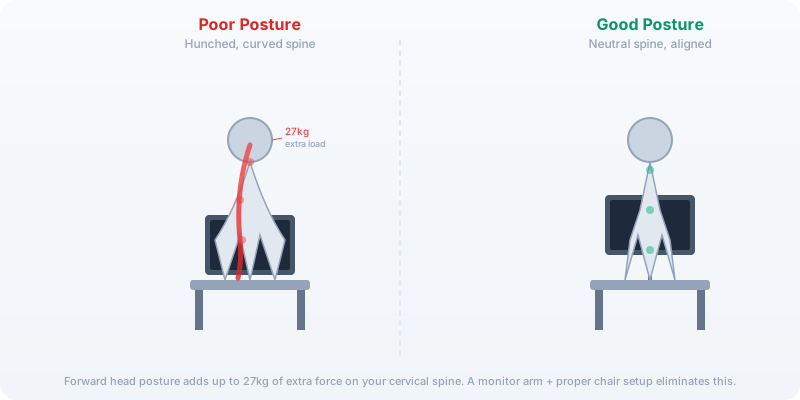
A 2024 PubMed follow-up review of workplace ergonomic interventions found that sit-stand desks reduced reported lower back pain by 32% on average over 3-month periods — but only when combined with proper ergonomic setup and posture awareness. Simply standing all day with a poorly positioned monitor created new problems.
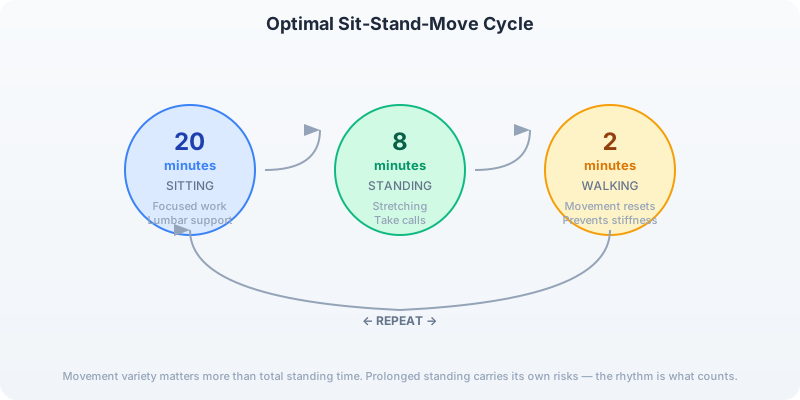
The takeaway: alternating between sitting and standing, with proper ergonomics in both positions, produced the best outcomes.
What Standing Desks Don't Do
- They don't replace exercise. Standing is not a workout. You still need regular physical activity.
- They don't fix a bad chair. If you're sitting in a terrible chair for 6 hours, standing for 2 hours helps — but the root problem remains.
- They don't work without movement. Standing perfectly still for hours creates its own set of problems (foot pain, varicose vein risk, joint compression). The magic is in switching positions throughout the day.
The Protocol That Actually Works
Based on the research consensus, here's what the evidence supports:
- Sit 20–30 min → Stand 20–30 min → Move 5 min. Repeat. The exact ratio matters less than the variation. Your body thrives on position changes.
- Set your standing desk height correctly. Elbows at 90°, screen top at eye level, wrists straight. A poorly adjusted standing desk is worse than a well-adjusted sitting setup.
- Use an anti-fatigue mat if standing >30 min at a time. Mats reduce lower limb discomfort by ~30% in workplace studies — but skip the $100+ gimmick mats; a basic $30 mat does the same thing.
- Don't stand after lunch. Standing on a full stomach increases acid reflux risk. Sit for the first hour post-meal.
Ready to try a standing desk? We tested 8 desks under $300 — see our top picks →
Bottom Line
Standing desks are a useful tool — not a health revolution. The evidence supports them for reducing back pain, improving comfort, and encouraging more position changes throughout the day. But if you buy one expecting to lose weight or live longer, you'll be disappointed.
The best desk setup is the one that gets you moving between positions. A $200 standing desk with good ergonomic habits beats a $2,000 setup you never adjust.
Sources
- JAMA Network Open, "Energy Expenditure During Sitting and Standing," 2024 Meta-Analysis
- BMJ Editorial, "Sedentary Behavior and Cardiovascular Risk," 2024
- Circulation, "RESET-BP: Sit-Stand Workstation Effects on Blood Pressure," 2024
- PubMed Review, "Workplace Ergonomic Interventions and Musculoskeletal Outcomes," 2024
- American Journal of Epidemiology, "Leisure Time Spent Sitting and Mortality Risk," 2010